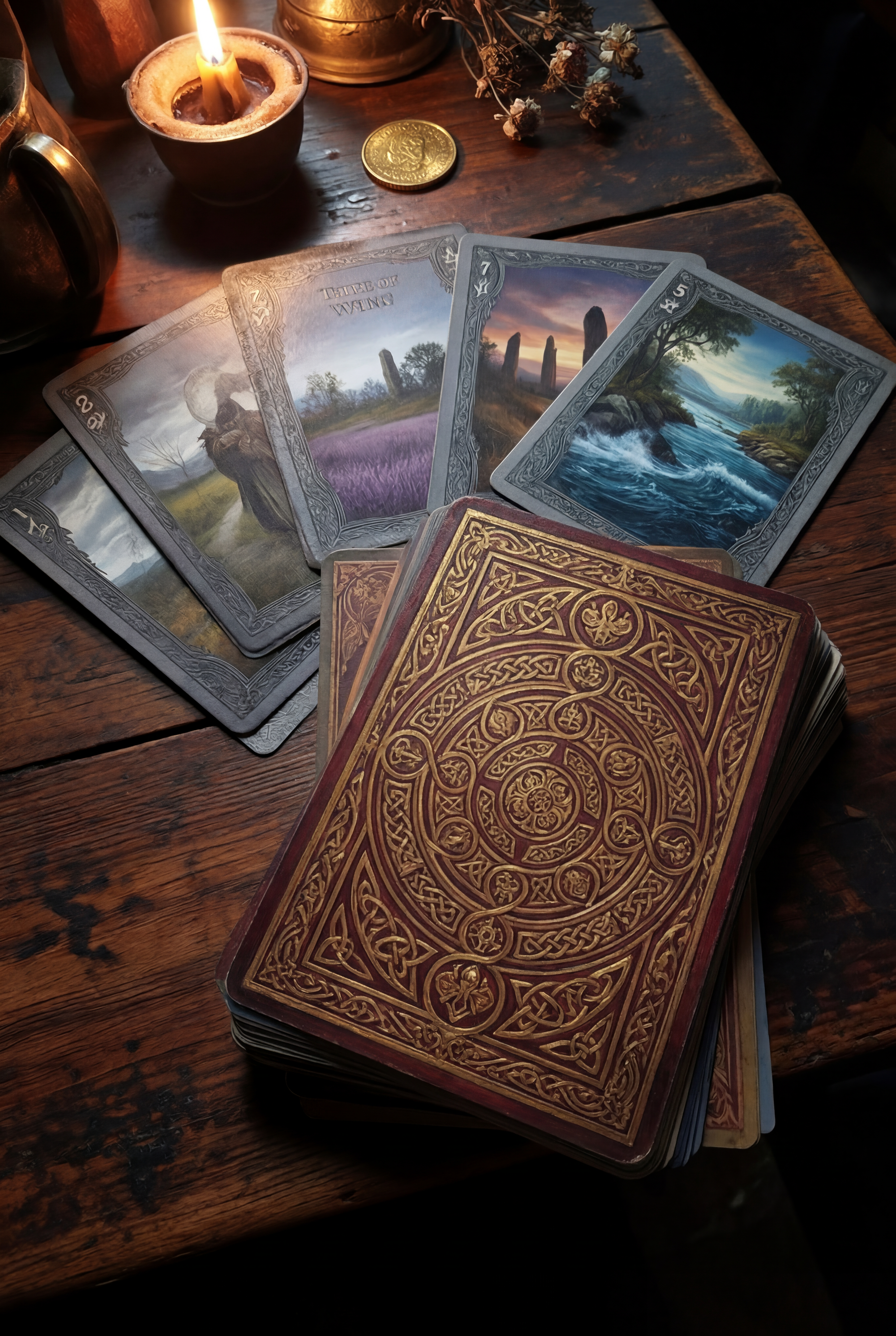
Forty-five cards. Five suits. Simple enough to learn over ale.
The card game of the Western Territories
Five suits. Simple enough to learn over ale. Deep enough to reveal character.
Forty-five cards. Five suits. Simple enough to learn over ale.
Forty-five cards. Five suits, nine cards each.
Suits (ranked lowest to highest): Wind — Stone — Tide — Flame — Eye
Each suit contains cards numbered one through eight, plus a Sovereign card.
Shuffle the deck. Deal five cards to each player. Place the remaining cards face-down as the Draw pile. Youngest player leads the first trick — tavern tradition, non-negotiable.
Two to six players. Four is considered ideal.
The lead player places one card face-up on the table. Clockwise, each other player plays one card. Any card may be played — there is no requirement to follow suit.
Resolving the trick:
The winner claims all played cards into their score pile and leads the next trick.
After each trick, all players draw back up to five cards from the Draw pile. When the Draw pile empties, play continues with remaining hand cards until all cards are played. The hand ends.
The most powerful card in any suit — and the most dangerous.
Played within its own suit: The Sovereign acts as a nine. It is the highest card in that suit and cannot be beaten except by a Sovereign from a higher-ranked suit.
Played and lost: If you play a Sovereign and lose the trick — because an opponent played a card from a higher suit — you pay the Sovereign's price. The winner takes additional cards from your score pile equal to the number of players at the table. In a four-player game, losing with a Sovereign costs you four cards from your own pile.
This is the game's central tension. A Sovereign played at the right moment wins decisively. A Sovereign played into the wrong trick bleeds you dry. Knowing when to hold it is the difference between a tavern gambler and a player.
The Eye is the highest suit. It beats Flame, Tide, Stone, and Wind.
The cost of seeing: When you win a trick with an Eye card, you must reveal one card from your remaining hand to all players, face-up, before the next trick begins. Choose which card to reveal.
Power buys information — for your opponents. The Eye wins every trick it enters, but each victory makes your hand more transparent. A player who leans heavily on the Eye wins tricks and loses secrets.
At the end of each hand, count your score pile:
Tavern game: First player to 50 points wins.
Quick game: First to 25.
The Long Draw (tournament format): First to 100.
The game rewards patience over aggression. Leading with high cards reveals strength. Holding back reveals nothing. The strongest players win by losing small tricks they do not need and winning the tricks that carry Sovereigns.
Suit counting is the advanced skill. Forty-five cards, five suits, nine per suit. A player who tracks what has been played knows what remains — and knows when a Sovereign is safe to play. Probability favors the attentive.
The Eye suit is a trap for the undisciplined. Winning five tricks with Eye cards costs you five reveals — nearly your entire hand made public. The best Eye players use it sparingly: one Eye card at a decisive moment, revealing a card they were going to play next anyway.
Optional. For taverns that prefer chaos.
Before dealing, remove one card from the deck at random and set it aside face-down. No player may look at it. It is returned to the deck only after scoring.
One missing card disrupts every probability calculation. The careful counter cannot be certain. The aggressive player cannot be sure. The game becomes a conversation with uncertainty.
Some tables play Wobble's Rule every hand. Some invoke it only when the evening has grown too predictable. Max insists the rule exists because Wobble once sat on a card and no one noticed until the hand was over, and the resulting argument about whether to replay was so entertaining that they made it permanent.
There is no evidence that this story is true. There is no evidence that it is not.